
Truth and Lies

We have allowed advertising to visually represent real people,  which viewers can then emulate. TV, then computers, internet and smartphones have progressively increased the sophistication and volume of these visually and auditorially  ‘realistic” (portraying a person or persons) media-which has magnified the impact on the viewing public to extraordinary levels. What are the consequences?

The Manufactured Self: How Advertising Saturation Creates a Society of Performed Emotions.

We have allowed advertising to visually represent real people,  which viewers can then emulate. TV, then computers, internet and smartphones have progressively increased the sophistication and volume of these visually and auditorially  ‘realistic” (portraying a person or persons) media-which has magnified the impact on the viewing public to extraordinary levels. What are the consequences?

The first known video advertising featuring a person selling a product,  appeared in the US in 1949 advertising a 12 inch Westinghouse Television, which (falsely) claimed that their new television eliminated rolling and static imaging on the screen, whilst conflating the image of the woman and the television set as being ‘easy on the eye’.

‘Video/archive: 1949 Westinghouse live TV commercial Archive

 Timeline

  • 1890s-1920s: Early movie advertising using projector slides and narrative product placements in silent films
  • 1913: The first movie trailer is produced for a stage show
  • 1941: The first licensed television commercial (Bulova watch) airs
  • 1949: The first known TV advert featuring a person (Westinghouse)

The development of electronic media over the last 75 years has thus allowed advertising to visually represent ‘real’ people which viewers can then emulate. TV,  then computers, the internet and smartphones have progressively increased the sophistication and volume of these visually and auditorially ‘realistic” media  (portraying a person or persons)-which has magnified the impact on the viewing public to extraordinary levels.

Thus genuine feeling in social interactions is frequently replaced by rehearsed facial expressions, simplified phrases and ready-made identities.

Only thirty years ago, the current exaggerated open-mouthed expression of pleasure or surprise was rare in advertising and public life. A restrained smile conveyed satisfaction. A raised eyebrow suggested interest. Communication was subtler, more coded, and — critically — more likely to be genuine. 

The shift began in the 1990s, driven by fashion photography and advertising, that discovered exaggerated facial expressions sold products more effectively. What followed was a gradual but relentless escalation.

Below is the chain of causation that has created this false world.

A. Advertising has saturated every media environment and increasingly every waking moment of human life.

B. Advertising operates primarily through emotional manipulation rather than truthful and factual representation.

C. This saturation and manipulation establish a kind of cultural template in which exaggeration, emotional performance, and the strategic misrepresentation of reality become normalized — not as aberrations, but as the default mode of social interaction.

D. People, having internalized this template, begin to present emotions they do not feel  — in their faces, their voices, their body language, their written words, their social media posts, and their consumer reviews — not because of malice, but because the entire communicative ecosystem has been engineered to reward performed emotion over authentic real emotions and experience.

This is the logical consequence of an advertising ecosystem that spends trillions of dollars annually teaching human beings that how you make people feel matters more than what is true (2), and that  ‘like-ability’ is the most predictive measure of commercial and personal success and infuence (2).

A car is associated with freedom. A drink is associated with belonging. A skin-care product is associated with confidence. A bank is associated with security. A fast-food meal is associated with family love. The message is not simply “buy this.” It is also “this is what happiness looks like,” “this is how desire should appear,” and “this is how a successful person responds.”

Marketing research treats emotional appeal as a central mechanism of persuasion because feelings can make a message seem personally relevant and memorable. The research is unambiguous: advertising succeeds not by providing information, but through performance of fake emotion. The University of Southern California’s analysis of advertising psychology found that 31% of emotionally driven ads succeed, compared to only 16% of rationally driven ads (2). The emotional response to an advertisement, ‘rather than the ad’s actual content, produces great influence on the intent of a consumer to buy a product” (2).

This finding is not just a description of what advertising does — it is a framework for how influence works in broader, (particularly Western) culture. When every person in a society is exposed to approximately 5,000 advertisements per day (2), they are receiving 5,000 daily lessons in a single method:  make people feel something, and they will do what you want.  The product being sold is irrelevant. The technique is transferable.

A person who has absorbed thousands of hours of emotionally manipulative advertising does not leave that training at the door of their workplace, their relationships, or their social media accounts. They have been taught, through relentless repetition, that performed emotion is the most effective tool of persuasion, and they will use it — often without conscious awareness that they are doing so, knowing that it works.

Workplaces already impose display rules on employees who must appear cheerful, calm or grateful regardless of their actual condition. Research on emotional labour shows that managing outward expression to meet such expectations can create strain, frustration and anger, particularly when the displayed feeling is far from the person’s lived experience.

Media and our ‘influencers’ from whatever source increasingly offer a smaller and smaller vocabulary of prefabricated phrases: “living my best life,” “good vibes,” “no negativity,” “you’ve got this,” “choose happy”- ad nauseam. These phrases can be comforting to the user in moderation. But they become emotionally impoverishing when they replace the harder work of identifying what is actually happening.

Look at any magazine cover, advertising campaign, or social media feed today and you’ll see it: the wide-open mouth. The gasp of delight. The hand over the heart. The breathless “Oh my God!” at a meal that is, after all, just a meal.

These expressions have become so ubiquitous that we rarely stop to ask a simple question: does anyone actually feel what they’re displaying? 

Advertising Normalizes Exaggeration as Communication

The historical research on advertising reveals that before regulatory oversight, “hyperbole became the norm. Every product was the best, new and improved, the easiest to use, the safest, the most reliable” – Dewey, 2021. Once advertising regulation curbed the most egregious factual claims, the industry shifted to emotional and associative manipulation — techniques that are harder to regulate precisely because they operate through feeling rather than fact.

In consequence, a culture’s dominant communicative mode — the one practiced by its most visible, most funded, most professionally skilled communicators — is one in which saying something better than it is is not a failure of ethics, but a success of the craft.

Advertising professionals do not consider themselves liars; they consider themselves storytellers. And this reframing — from deception to narrative craft — has seeped into wider Western culture, providing a ready-made rationalization and excuse for anyone who wishes to exaggerate, embellish, or perform emotions they do not feel.

The Influencer Culture

Prior to the advent of the smartphone, personalised advertising on TV, Video and Film was acted via paid performers. The viewer was usually aware that the performer was a paid actor and not authentically portraying themselves. Nevertheless, the expert paid performer could (and still can) portray an element of personal authenticity in the delivery of the script.

However with the advent of the smartphone, the most direct mechanism through which advertising’s emotional performance template has colonised everyday social behavior is  ‘influencer’ culture. ‘Influencers’ are, functionally, human advertisements — people who have monetized their personal lives opinions, and emotional expressions by making them persuasive to an audience.

Research on influencer authenticity demonstrates how thoroughly the advertising template has been absorbed into the viewers’ personal identity. The study found that perceived authenticity in influencers has a direct and indirect effect on consumer purchase intentions, mediated by trust and credibility (3). The standardized regression coefficient for trust (β = .44) reveals its centrality: audiences must believe an influencer is being genuine before they will be influenced by them (3).

‘Authenticity’  has consequently become a performance metric. Influencers do not simply need to ‘be authentic’; they must perform that authenticity convincingly enough to generate trust, which then generates purchasing behavior.

The research notes that “once the messaging of an influencer has been found to concur with the individual values and lifestyle of the followers, they are considered as intrinsically motivated and not extrinsically motivated by sponsorships, thus increasing the level of trust” (3).

Thus the most commercially valuable thing a person can do in the modern media ecosystem is convince others that their performed emotions are real. ‘Authenticity’ is not a quality to be possessed; it is a skill to be performed. And the better you perform it, the more influence — and money — you accumulate.

 The Collapse of the Authentic and the Manufactured

The logical endpoint of this trajectory is visible in the emergence of virtual influencers   — computer-generated personas that “replicate human appearance, personality, and social presence” while possessing “no memory, autonomy, or emotion” (4). Virtual influencers like Lil Miquela or imma.gram are entirely fabricated emotional performers. They do not (presumably!) feel anything. They have no bodies, no experiences, no inner space which makes meaning. Yet they engage audiences emotionally, generate trust, and drive purchasing behavior.

The research on virtual influencers reveals the cultural anxiety this produces: participants across multiple national contexts “expressed distinct thresholds for emotional resonance and divergent ethical concerns, particularly regarding disclosure, manipulation, and perceived authenticity” (4). The study introduces the concept of   “synthetic mis-recognition”  — the phenomenon of mistaking simulated emotion for real emotion — and argues that this mis-recognition has profound implications for “the ethics of simulating relational authenticity” (4).

But virtual influencers are not an aberration. They are the purest expression of what advertising has always taught:  that performance of emotion is more valuable than the experience of it. If a computer-generated character with no feelings can sell products by performing feelings convincingly, then the message to every human content creator, social media user, and consumer is clear: your real feelings are less important than your performed ones. 

 Ordinary People as Advertisers of Themselves

The advertising template has spread beyond influencers and virtual characters to ordinary consumers. Research on inflated consumer testimonials found that psychological and emotional factors — including “self-image, self-enhancement as well as motivations for retribution against service providers” — significantly predict the creation of exaggerated, amplified review content (7).

The researchers frame this within Interpersonal Deception Theory, noting that “certain individuals tend to misrepresent facts and may willingly decide to deceive other persons, in their daily conversations, including in virtual ones” (7). The motivations are not solely selfish; they may include altruistic intentions, constructive criticism, and self-image management — all of which are emotional performances designed to create a particular impression in the minds of others.

What is significant though is that ‘ordinary’ people have adopted the exact techniques that advertising uses: exaggeration, emotional framing, selective emphasis, and the construction of a narrative designed to persuade rather than inform. The consumer writing an inflated review is doing, in miniature, exactly what a television advertisement does — making something sound better, more dramatic, and more emotionally resonant than it actually is. The advertising template has been democratised. Everyone is now their own advertising agency!

However the personal energy required to perform and deceive, rather than to simply express emotion, takes a considerable toll on both the performer and the receiver.

 The Demand for Displayed Emotions

The chain of causation now becomes self-reinforcing. In a culture saturated with advertising and advertising-derived content (influencers, branded social media, curated personal narratives), the display of emotion becomes a social requirement. If everyone around you is performing emotion — performing happiness, enthusiasm, gratitude, outrage, desire — then the failure to perform emotion becomes conspicuous. It reads as coldness, disengagement, or social incompetence.

The research on virtual influencers captures this dynamic precisely: their appeal lies in their capacity to “emotionally engage users, often blurring the line between simulation and sincerity” (4). When the dominant mode of social interaction — mediated through screens, platforms, and algorithmically curated feeds — is one of performed emotional engagement, then real authenticity becomes not the natural state but the exception. The baseline expectation of interactions between people becomes performance.

The research on emotional abuse patterns identifies a key dynamic that applies metaphorically to the advertising-saturated culture:   “You’re a different person around them. You find yourself doing and saying things you normally wouldn’t do but you have to in order to get through the interaction”   (1).

 In the advertising-saturated media environment, the “them” is not a single abuser but the person’s entire social ecosystem. People become different versions of themselves — performing emotions they do not feel, saying things they do not believe, presenting images that do not correspond to their reality — because the ecosystem demands it.

The Deceptive Design of Emotional Environments

The research on deceptive design in extended reality environments provides a technological dimension to this argument. XR (extended reality) technologies “enable new deception opportunities that are not present in other digital environments,” including the capacity for companies to  “induce artificial emotions and target vulnerable users to influence their purchasing decisions”  (6).

The study identifies that XR’s “immersive capabilities and extensive data collection enable subtle and powerful manipulation strategies” (6), and that these technologies can create emotional states in users that are then leveraged for commercial purposes. The concept of “emotional transparency”  (from the virtual influencer research) becomes relevant here: in immersive advertising environments, the boundary between genuine emotion and induced emotion dissolves entirely (4). The user does not know whether they are feeling something real or something manufactured — and in a culture that has already normalized emotional performance, they may not care.

The Feedback Loop: Performed Emotion Becomes the Standard

The final link in the chain is the feedback loop.

Advertising teaches emotional performance. Influencers monetize emotional performance.Ordinary consumers adopt emotional performance.

Technology platforms are designed to induce and reward emotional performance. And at each stage, the  threshold for what counts as “authentic” emotion is raised, because the culture has become so saturated with performed emotion that genuine emotional expression becomes indistinguishable from — and often less compelling than — its performed counterpart.

The research on influencer marketing confirms this: audiences rate “authenticity” not as the presence of genuine emotion but as the consistency, transparency, and personal relatability  of the influencer’s performance (3).

A perfectly constructed performance of vulnerability will be rated as more “authentic” than a genuine but awkward expression of feeling, because the audience has been trained — by thousands of hours of advertising — to evaluate emotion on the basis of   how well it is presented, not on whether it is real.

Emotional Alienation

When a person is required, by the structure of their social and commercial environment, to perform emotions they do not feel, the predictable consequence is a form of emotional alienation — a disconnection from one’s own (and other’s)  internal emotional states.

The research on emotional abuse identifies this pattern at the individual level: victims report becoming “a different person” around their abusers, doing and saying things they would not normally do (1).

At the societal level, the same dynamic operates through the advertising-saturated media environment, which requires constant emotional performance and thereby erodes the individual’s connection to their actual feelings.

The Erosion of Trust

The research on inflated testimonials identifies a direct consequence of widespread emotional exaggeration: “A lack of credibility and trustworthiness in online reviews could negatively affect the consumers’ perceptions and attitudes toward the business” (7).

 When everyone is performing, no one can be trusted — not because individuals are necessarily malicious, but because the ecosystem makes authentic communication structurally impossible.

The virtual influencer research describes this as a crisis of “emotional transparency” (4), and the deceptive design literature frames it as a problem of   “synthetic misrecognition”   (4) — the inability to distinguish real from performed emotion.

The Manufacture of Psychopathic Norms

Psychopathy, in clinical terms, is characterized not primarily by violence, but by superficial charm, manipulative behavior, and the absence of genuine emotional experience.

A culture that rewards emotional performance over emotional truth, that monetizes the appearance of authenticity, and that saturates every media environment with manufactured feeling, is a culture that structurally incentivises the behavioural profile of psychopathy — not because its members are all psychopaths, but because the system selects for psychopathic performance. This is especially true for those we deem as ‘leaders:-our politicians, our sports ‘heroes’, our cultural icons…

One of the key issues is that emotional awareness is not an ‘ornamental’ skill. It is vital to help people decide what they need, to communicate boundaries, to seek help, to  repair relationships and to regulate others’ and their own behaviour.

It must  be acknowledged however, that people differ in how they experience and communicate emotion, and our  interpretations of others’,  and our own emotions, must respect culture, neurodiversity, trauma history and individual circumstances. Emotional abuse, emotional neglect and physical neglect can have a profound effect on our capacity to express and understand the emotions of others.

The Advertising-Emotion-Deception Nexus

The argument, traced through the available research, can be summarised thusly:

Advertising’s saturation of all media(2) — from television to social media to extended reality environments (6) — has established  emotional manipulation as the dominant mode of commercial communication(2).

This mode operates through exaggeration, selective framing, and the construction of inspirational emotional narratives that make products, services, and experiences sound better and more emotionally rewarding than they actually are.

This commercial template has been  absorbed into broader culture  through more and more sophisticated technology and influencer marketing (3), consumer review culture (7), social media performance, and the design of immersive digital environments (6).

Ordinary people, trained by thousands of daily exposures to emotionally manipulative advertising, have adopted the same techniques in their own self-presentation — performing emotions they do not feel, exaggerating their experiences, and constructing curated emotional narratives designed to persuade others rather than to communicate truthfully (7).

The result is a society in which   emotional performance has replaced emotional experience  as the default mode of social interaction — a society in which authenticity is a skill to be performed (3), in which computer-generated characters with no feelings can convincingly simulate emotional connection (4), and in which the structural demands of the media ecosystem may be   engineering behaviors associated with emotional manipulation and the absence of genuine feeling. 

While research remains limited on the issue, the societal  frequency and intensity of alexithymia, a behavioural trait characterised by poor emotional awareness and description, may also  be compounded by this advertising blitz of fake emotion. 

There is a growing unease in modern life. People can be surrounded by messages, images, notifications, opinions and invitations to buy, yet remain strangely unable to say what is happening inside them. We may know that we are “stressed,” “fine,” “triggered” or “happy.” But we may not know whether we are grieving, ashamed, lonely, frightened, resentful, exhausted or morally disturbed.

This is Alexithymia: it is not the absence of emotion. It is a reduced ability to notice, identify and describe one’s own feelings. It is generally understood as a dimensional, subclinical trait rather than a diagnosis in itself. Researchers commonly describe three features: difficulty identifying feelings, difficulty describing them to others, and an externally oriented thinking style that focuses more on facts and events than inner experience.

Are increasing numbers of people becoming alexithymic? The evidence does not yet establish a comparable, population-wide rise across the past several decades. Studies use different samples, cultures, questionnaires and thresholds. Some report high rates in particular groups, especially adolescents, students and people experiencing mental or physical illness. Those findings cannot be converted into a reliable global trend.

Nevertheless, there are good reasons to take the possibility seriously. Modern societies expose people to chronic stress, childhood adversity, loneliness, commercial pressure, digital distraction and a powerful demand to display emotions that are legible, attractive and useful.

Visual  displays like fist pumps or wide open mouths become a clearer expression to others when displayed on  a small  screen, as opposed to the subtle and multiple visual, auditory and chemical  transmissions that (can) occur in real social  settings. 

We may be living in a culture that is increasingly emotionally performative while becoming less emotionally literate.

The Profound Impacts on Younger People

A child learns emotional language through their relationships. A responsive adult helps a child connect bodily states with words: “You are frightened,” “That hurt,” “You are disappointed,” “It is safe to be angry without hurting someone.”

When adults ignore, ridicule, punish or exploit a child’s feelings, the child may learn that inner experience is dangerous, useless or incomprehensible-  so much safer and easier then, to  just  perform the required emotional  display.

When feelings remain unnamed and unrecognised, they can be harder to regulate and easier to express indirectly through withdrawal, aggression, compulsive activity, substance use or physical symptoms.

Young people are not simply more vulnerable to advertising because their brains are immature, but advertising-saturated digital environment may also be actively impairing the development of the brain regions that would eventually allow them to resist advertising’s influence (17).

 Children learn to identify and express emotions partly through  mirroring   — observing how the adults around them respond to situations. If those responses are consistently exaggerated or performative, children internalise a distorted model of emotional life.

In addition, younger people are particularly vulnerable to  this ‘selling’ onslaught  because of their more limited experiences of life, and consequently often model  these exaggerated  behaviours by ‘influencers’  and other salespeople in  the media who  are thus deemed to  be ‘important’  and of high social status.

Young people are not merely more susceptible to advertising. They are being shaped by it at the neurological, psychological, and identity levels  in ways that make performed emotion not a choice but the default response.

That is not to say that we should simply ban young people from  accessing ‘social media’. What  is needed instead is more effective parental  and school-based training on how to educate and support children in safely and honestly engaging in real social settings.

With these skills and confidence, electronic social and other media and advertising becomes far easier and safer to navigate for a young person.

CONCLUSION

Let us not however deceive ourselves that humanity’s capacity to deceive each other and ourselves is somehow a new or unique ‘skill’ brought about by advertising! Propaganda techniques have been around for more than 2000 years!

The capacity to fake, to pretend and to deceive are not just  human  traits-  they are traits exhibited by all species from  time immemorial to extend the survival of the individual and the group.

What is unique however, is its current and pervasive prevalency in modern human society- an adaptation from a survival mechanism to a default mechanism for social acceptance and consumption.

Additionally, it has to be said that new communicative styles (a wide open mouth, a fist pump, or  an OMG) are not solely the result of media inputs.

The human brain’s insatiable need for ‘more’ has been supercharged through  advertising media and the technologies which have enabled saturation advertising.

On a finite planet, humanity’s insatiable need for ‘more” has only one outcome…

A population that cannot name its feelings is easier to manipulate through fear, resentment and commercial desire. Public debate becomes a contest between emotional triggers rather than an effort to understand competing needs. People who are grieving are told to be positive. People who are angry are offered an enemy. People who are lonely are offered a product.

Human societies function on an  assumption of trust that others are, predominantly, communicating what they actually feel. Facial expressions evolved as honest signals. A genuine smile — the Duchenne smile, involving the muscles around the eyes — was a reliable indicator of real pleasure. We are neurologically wired to trust these signals. 

Without that  baseline of trust between its individuals,  a community, a  society, a culture, or a global  culture, become fragmented, distrustful and fearful. Skepticism and social fatigue become the norm.  When people cannot easily distinguish genuine emotion from performance, they may withdraw from emotional engagement altogether. And if we assume everyone around us is performing, we become less likely to respond with genuine compassion to someone’s real distress. Manipulation becomes that  much easier.  When the language of strong emotion is constantly performative, those who genuinely wish to deceive find easy fertile ground.

There is also an ecological consequence. The destruction of forests, rivers, animals and climate systems is not just a technical problem. It is a failure of relationship and moral perception. If people are trained to treat their own inner discomfort as noise, they also become less able to register the suffering of other humans, other species and the wider living world.

We must rebuild our emotional vocabulary and skills, develop and encourage honest communication, trauma-informed care, and revitalise institutions that allow real feeling of expression rather than requiring permanent positivity.

We must  begin to make room for experience and emotional states  that are less scripted and more honest.

Families and schools can teach children a richer emotional vocabulary without forcing them to perform it. Workplaces can question display rules that require permanent cheerfulness. Health services can ask about emotional awareness without dismissing physical symptoms.

Communities can create places where people are allowed to be uncertain, vulnerable, grieving, or conflicted and still worthy of belonging.

Research Sources and URLs

(1) :Emotional abuse signs and healing, personal testimony: Being “a different person” around others as a sign of manipulation; the pattern of performing emotions to survive an interaction

 (2): USC Applied Psychology — “Thinking vs Feeling: The Psychology of Advertising” :31% emotional vs 16% rational ad success; 5,000 ads/day; likeability as the primary predictor of ad effectiveness

(3): Influencer authenticity, trust, and purchase intentions (Gen Z): Perceived authenticity mediates purchase behavior through trust (β = .44) and credibility; authenticity is a performed quality

(4): Virtual influencers: ethical and cultural dimensions (Myanmar, South Korea, Singapore, USA) :Synthetic misrecognition; emotional transparency; VIs simulate emotion without experiencing it; cultural variation in ethical discomfort

(6): Deceptive design in Extended Reality (University of Waterloo, 2024): XR enables “inducing artificial emotions” and targeting vulnerable users; immersive manipulation strategies |

(7): Inflated consumer testimonials: self-image, self-enhancement, retribution motivations: Self-image and self-enhancement predict exaggerated reviews; ordinary consumers adopt advertising’s techniques of exaggeration

(8): Hogeveen & Grafman, 2021, Alexithymia (Handbook of Clinical Neurology; PMC8456171). Alexithymia is a subclinical construct involving disrupted emotional awareness. It is linked to impaired functional outcomes and treatment response; major issues include emotional awareness, communication, interoception, and measurement. URL: https://pmc.ncbi.nlm.nih.gov/articles/PMC8456171/

(9): Kick et al., 2024, Alexithymia as a mediator between adverse childhood events and the development of psychopathology: a meta-analysis (Frontiers in Psychiatry; PMC11246998 ). Meta-analysis found child abuse correlated with alexithymia (r=.26), alexithymia with general psychopathology (r=.44); emotional abuse, emotional neglect, and physical neglect were stronger correlates than physical/sexual abuse. Mediation is partial and correlational. URL: https://pmc.ncbi.nlm.nih.gov/articles/PMC11246998/

(10): Ursoniu et al., 2024, The interconnection between social media addiction, alexithymia and empathy in medical students (Frontiers in Psychiatry; PMC11446739 ). Cross-sectional sample of 649 medical students. 21.42% possible and 14.02% clear alexithymia by TAS-20 thresholds. Model found social-media addiction associated with alexithymia and an indirect association with empathy; only about 11% of empathy variability explained, single-site student sample, no causal inference. URL: https://pmc.ncbi.nlm.nih.gov/articles/PMC11446739/

(11): Tsubaki & Shimizu, 2024, Psychological Treatments for Alexithymia: A Systematic Review (Behavioral Sciences; PMC11673933 ). Review of 18 RCTs / 21 intervention arms / 1,251 participants. Most psychological interventions reduced TAS-20 scores, but studies were heterogeneous and larger, higher-quality trials are needed.URL: https://pmc.ncbi.nlm.nih.gov/articles/PMC11673933/

(12): Advertising evidence: marketing research documents emotional appeals as a central persuasive strategy; research on social-media self-presentation finds expressions are often idealized, exaggerated, and unrealistic. These sources support discussion of a cultural environment of performed and commodified emotion, not proof that advertising causes alexithymia. URLs: https://link.springer.com/article/10.1007/s43039-026-00136-2 ; https://www.nature.com/articles/s41467-020-18539-w

(13): Emotional-labour literature defines display rules as explicit or implicit expectations to show particular emotions, and links inauthentic display to strain/burnout in some settings. This supports a cautious analogy to commercial emotional display, not a direct clinical claim. URL: https://pmc.ncbi.nlm.nih.gov/articles/PMC10863272/
How Gulf Oil Disruptions Threaten Australia and New Zealand’s Energy Security

The Global Context: A Crisis Without Precedent

The closure of the Strait of Hormuz has created what the International Energy Agency calls “the largest supply disruption in the history of the global oil market” . Flows through the Strait—normally carrying 20 million barrels daily—have fallen to “a trickle,” with oil exports from Gulf producers dropping from approximately 20 million barrels per day to just 3.8 mb/d in early April .

This isn’t just about crude oil. The crisis has triggered unprecedented price spikes in refined products, with Singapore middle distillate prices reaching all-time highs above $290/barrel . For Australia and New Zealand—nations at the end of global supply chains—the implications are immediate and severe.


Price Forecasts: What to Expect by June 2026

Given that the war against Iran by Israel and the US is an existential one for Iran- i.e. Israel, and likely the US’s intent, is to destroy Iran as a cohesive state and break it into statelets who can no longer pose a threat to Israel’s Greater Israel project or disrupt future US control over Iranian oil, any peace agreement for Iran must include continued control over the State of Hormuz to ensure the state of Iran’s continued viability. It is unlikely that the US will concede to this in the short to medium term, especially given the control that Israel currently has over US foreign policy.

Additionally, should the US attempt further substantial attacks on Iranian infrastructure after the ceasefire likely ends on May 20th 2026, Iran has promised to destroy other Gulf States energy infrastructure.

If the Strait of Hormuz remains closed or severely constrained through June 2026 or longer, energy markets face a prolonged supply crisis with cascading price effects:

Crude Oil and Refined Product Prices

ProductCurrent/Recent PriceJune 2026 Forecast (Hormuz Closed)Source
Brent Crude~$103/bbl (March avg)$115+/bbl (EIA peak forecast for Q2 2026)
Singapore Gasoil (Diesel)$192/bbl (April)$200-250+/bbl (IEA alternative scenario)
Singapore Jet FuelSurged 114% since Feb 28$250-300+/bbl (record highs sustained)
VLSFO (Bunker Fuel)S$2.30/litre (Singapore)S$2.50-3.00+/litre (competing demand from refiners)
Australian Retail DieselAUD $3.20+/litreAUD $3.50-4.00+/litre (potential doubling if crisis persists)
Australian Retail Petrol~$2.20/litre (post-excise cut)AUD $2.50-3.00/litre
US Retail Diesel~$5.80/gallon (April peak)$6.00-7.00+/gallon

The International Energy Agency (IEA) has presented two scenarios: a base case assuming gradual resumption of Hormuz flows by mid-year, and an alternative “prolonged conflict” case where “energy markets and economies around the world need to brace for significant disruptions in the months to come”. Under the prolonged conflict scenario, physical crude prices could sustain levels near $150/bbl, with refined products trading at unprecedented premiums .

As of mid-April 2026, oil futures traders are maintaining an almost constant West Texas Intermediate (WTI) crude oil price per barrel of around $100 US, while real Dated oil prices hover around the $140 mark. Futures traders are for some reason responding to oft repeated wild claims by Trump that victory, a peace agreement or at least an opening of the Straits, is imminent.

The IEA estimates it will take 2 years for global oil supplies to return to their previous levels once the Strait is reopened because of the extensive damage to Gulf refineries, storage facilities and docks.

Key Price Drivers

  • Diesel shortage structural: The IEA estimates 3-4 million barrels per day of diesel supply loss (5-12% of global consumption) directly tied to Hormuz disruptions
  • Refinery capacity offline: Middle East and Asian refineries cut runs by ~6 mb/d in April, tightening global product markets
  • Brent-WTI spread widening: The spread reached $12/bbl in March and is projected to peak at $15/bbl in April, reflecting Asian supply anxiety

Australia: The Diesel Nation at Breaking Point

The Dependency Problem

Australia is perhaps the most vulnerable developed nation to a liquid fuel emergency. In FY2021, 91% of all fuel consumed in Australia was imported—including 68% as refined products and imported crude for our remaining refineries .

Over the past 20 years, Australia like many other Western countries has substantially reduced the number of oil refineries on shore, opting instead for those refineries to become solely storage facilities for distilled oil products; predominantly from Asia. Two active refineries remain in Australia with the smaller one recently impacted by a refinery fire.

Australia sits at the end of a complex supply chain stretching thousands of kilometers from Singapore, South Korea, Malaysia, and Japan. While only a small fraction of their diesel imports come directly from the Middle East, almost half of the crude oil for production of that diesel originates in the Middle East when traced back through those Asian refineries.

The Diesel Consumption Profile

Australia’s economy runs on diesel. In 2025, the nation consumed approximately 35 billion litres of diesel—far exceeding the 15 billion litres of petrol and 10 billion litres of aviation fuel . The consumption breakdown reveals critical vulnerabilities:Table

SectorDiesel ShareAnnual ConsumptionVulnerability Level
Mining40% of total diesel~14 billion litresCRITICAL
Road Transport/Trucking24%~8.4 billion litresHIGH
Agriculture8%~2.8 billion litresHIGH
Manufacturing7%~2.5 billion litresMEDIUM
Marine/RailSignificant~3+ billion litresMEDIUM
Passenger Vehicles~25% of remainder~4+ billion litresMEDIUM

Australia has one of the highest per capita diesel demands in the world—7.4 barrels per person annually—far exceeding the US and other major economies .

The Refinery Crisis

Australia’s domestic refining capacity has collapsed. Five refineries closed over the last decade, leaving just two operational: Ampol’s Lytton refinery in Brisbane and Viva’s Geelong refinery in Victoria. These facilities were already struggling before the current crisis—and then came the April 2026 fire at Geelong.

The fire at Viva Energy’s Geelong refinery—built in the 1950s—shut down critical units. As analyst Kevin Morrison noted: “This creates the conditions for higher prices, as it pushes up international demand for refined products when supply is massively constrained. It could not happen at a worse time.” Victoria alone consumes 252,000 barrels of fuel daily—41% diesel, 22% jet fuel—and now faces sourcing these volumes from already-tight Asian markets.

The structural problem? Our remaining refineries are configured to produce mostly petrol rather than aviation fuel and diesel—precisely the fuels most critical for agriculture, road freight, mining, and defense .

Stockholding: The 90-Day Myth

Australia has been in breach of International Energy Agency (IEA) obligations since 2012. The IEA requires 90 days of net import coverage; Australia holds just 68 IEA days, and when measured against actual consumption, this equates to roughly 30-34 days of real fuel security .

The government counts “fuel in transit”—on foreign-flagged tankers in foreign ports—toward reserves. But as the Australia Institute notes: “In the event of a global emergency, there is no guarantee that the oil that Australia has been promised access to… would be practically accessible.” These ships are not Australian vessels; they sail under foreign flags and owe no allegiance to Australian fuel security.

With the Strait closed, Australia is now pulling diesel along some of the longest and most expensive trade routes in the world—13,000-mile journeys from the US Gulf Coast taking up to two months .

Mining Sector: The $4.5 Billion Diesel Addiction

The mining industry is Australia’s most diesel-exposed sector, consuming approximately 9.6 billion litres annually—roughly 40% of national diesel consumption and 10% of total national energy use . The sector operates more than 50,000 large diesel-powered trucks, each consuming approximately 900,000 litres annually .

Cost Impact Calculations:

  • At pre-crisis diesel prices (~AUD $1.75/litre), a large mine’s annual fuel bill for a 200hp tractor running 1,500 hours was ~$74,000
  • At current prices (~AUD $2.25-2.50/litre), that same operation costs $100,000-112,000 annually—a 35-50% increase
  • If prices reach $3.50-4.00/litre by June, costs could double from the original baseline

According to S&P Global and BMO estimates using Wood Mackenzie data, every 10% increase in oil prices drives mining cost increases of:

  • Iron ore: +4.2% mining costs
  • Copper: +3.5% mining costs
  • Gold: +2% mining costs

With crude oil potentially averaging $100+/bbl (47% above 2025 average), mining costs could rise 16-20% for bulk commodities .

Operational Risks: The mining industry faces a shutdown timeline measured in weeks if diesel supplies are interrupted:

  • Best-positioned mines: 4-8 weeks of operational capacity
  • Typical remote diesel-heavy mines: 2-6 weeks before curtailment
  • Weakest operations: Days to 2 weeks

The ASX Materials Index has already plunged 20.3% since the conflict began, with fund managers dumping stocks amid fears of fuel shortages forcing production cuts .

Agriculture: Harvest Season Crisis

Australian agriculture consumes approximately 2.5 billion litres of diesel annually, with diesel accounting for 84% of on-farm energy consumption . The crisis has hit at the worst possible time—during harvest season when fuel demand peaks .

Impact on Farm Economics:

  • A farm using 80,000 litres annually faced fuel costs of ~$140,000 at $1.75/litre pre-crisis
  • At current $2.25+/litre, costs have jumped to $180,000+ annually—a $40,000+ increase per farm
  • If diesel reaches $3.50/litre by June, that same farm faces $280,000 annual fuel costs—double pre-crisis levels

Farmers are already making critical decisions about whether to proceed with crops given uncertainty about diesel allocations later in the year . Adding diesel and freight costs means nearly 60% of farmers’ cost base is increasing rapidly .

The Fuel Tax Credits Scheme (FTCS)—which provides AU$4.5 billion annually to mining and AU$1.3 billion to agriculture—has become a critical but increasingly inadequate buffer .

Food Supply Chain: From Farm to Shelf

Australia’s food supply chain is diesel-dependent at every stage:

  • Production: Tractors, harvesters, irrigation pumps
  • Processing: Generators, machinery
  • Distribution: Road trains, trucking (24% of national diesel consumption)

Higher diesel costs cascade through the food system:

  • Transport costs increase directly with fuel prices
  • Processing costs rise due to diesel-powered equipment
  • Retail prices must absorb these increases or face margin compression

The Australian Industry Group warns that disruption to fuel markets creates cascading supply chain impacts, with businesses already reporting fuel-related operational challenges .

Tourism and Aviation

The tourism sector faces a triple hit:

  1. Jet fuel costs: Singapore jet fuel surged 114% since February 28
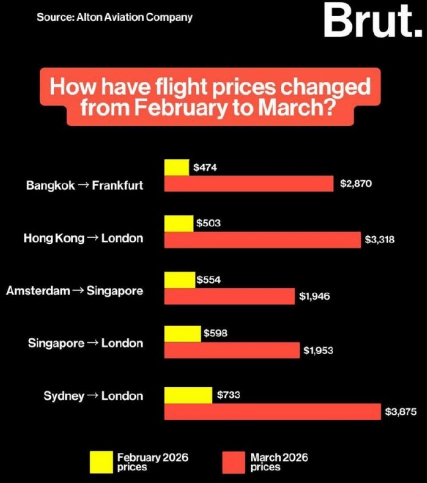
  2. Airfare increases: AirAsia X has increased fares by up to 40% due to fuel costs
  3. Ground transport: Higher petrol and diesel costs affect rental cars, tour buses, and visitor travel patterns

Air New Zealand has already canceled 1,100 flights impacting over 44,000 passengers between March and early May due to fuel cost pressures .

The Australian Government Response

On March 30, 2026, the Australian National Cabinet activated the National Fuel Security Plan, currently at Level 2 (“Keeping Australia Moving”) . Measures include:

  • Halving fuel excise from 52.6 cents to 20.6 cents per litre for three months
  • Temporarily reducing minimum stockholding obligations by 20% for diesel and petrol
  • Amending fuel quality standards to allow higher sulfur levels, releasing ~100 million litres/month of additional petrol supply
  • Appointing a Fuel Security Taskforce Coordinator
  • Underwriting additional fuel cargoes and strategic reserves

However, energy analysts question whether the excise cut was optimally targeted. Macquarie University’s Lurion De Mello notes: “Petrol is not the pain point. Diesel is the pain point” . Deakin University’s Samantha Hepburn warns: “Any disruption in diesel supply or sustained high prices… will directly affect production capacity, increase operating costs and ultimately push up food prices” .

The Australia Institute recommends accelerating electric vehicle adoption to reduce petrol demand, thereby freeing refining capacity for diesel and jet fuel security .


New Zealand: The Marsden Point Gamble

The Refinery Closure Decision

New Zealand made a calculated bet in 2022—and now faces the consequences. The Marsden Point refinery, which produced half the country’s petrol, two-thirds of diesel, and most jet fuel, was converted to an import terminal. The rationale was economic: the refinery was inefficient by international standards, and importing refined products from mega-refineries in Asia was cheaper.

The government and industry argued this improved security: “Closing the refinery has actually improved our security of supply, as there is now more than twice as much fuel on the water to replenish domestic stocks than when we produced it locally.”

But this logic contains a fatal flaw. New Zealand no longer imports crude oil—but the Asian refineries we depend on do. In 2024, New Zealand’s top four source countries (Singapore, South Korea, Malaysia, Japan) sourced almost 80% of their crude oil imports from Persian Gulf countries .

As MFAT’s July 2025 analysis states: “In the event of disruption of Middle Eastern supply, Asian refineries would be forced to source crude product from elsewhere, pushing up the global price for oil” . New Zealand faces indirect but severe exposure to Gulf disruptions through our refined product suppliers.

Current stock levels provide approximately 47 days of diesel, 51 days of petrol, and 49 days of jet fuel coverage—better than Australia but still precarious if Asian refining capacity falters .

As of mid-April 2026, the New Zealand government’s sole strategy has been to monitor the volume and consequent days left of the various oil substrates in the country. The reality is that the risks to New Zealand’s economy are the combined factors of stocks available and the cost at the pump of those stocks New Zealand may well find that by June there are still tankers available to supply oil substrates to New Zealand but at a price that is unaffordable to the public.

Already truck operators are warning of hugely increased supermarket food prices in the pipeline because of the massively increased transport costs involved in supplying the supermarkets from New Zealand’s highly centralised grocery supply chain. Decentralisation of essential services across new Zealand is thus a very urgent priority.

Economic Impact Forecasts

ASB Bank has downgraded New Zealand’s growth outlook due to the fuel crisis, forecasting:

  • GDP growth slowing through 2026
  • Inflation rising toward 4% before easing in 2027
  • Households facing $4,000-6,000 annual hit if fuel prices stay elevated

Westpac identifies tourism as particularly vulnerable, forecasting that “the most direct impact of the shock on exports will likely show up in falling visitor numbers” due to flight disruptions, higher airfares, and consumer reluctance to travel internationally during heightened tensions .

Tourism Sector Impact

New Zealand’s tourism sector—still recovering from COVID-19—faces severe headwinds:

  • Flight cancellations and route reductions: Air New Zealand has already cut capacity
  • Higher airfares: Jet fuel costs have surged 114%, forcing ticket price increases
  • Reduced international visitor numbers: Westpac expects reversal of recent strong growth in arrivals
  • Domestic tourism pressure: Higher petrol prices reduce Kiwis’ willingness to travel domestically

Regional Variations: Regions dependent on self-drive tourism—West Coast, Tasman, Southland, Gisborne—face particular pressure. These areas already have disproportionate visitor spending on fuel, primarily because of a lack of local international airports, making them vulnerable to petrol price volatility .

Tourism Industry Aotearoa reports businesses are experiencing “sharp increase in business costs as a result of the leap in fuel prices” . The NZX50 fell nearly 6% in March 2026, with travel and tourism stocks—including Serko, Air New Zealand, Tourism Holdings, SkyCity Entertainment, and Auckland International Airport—among the hardest hit .

The Political Reckoning

The Marsden Point closure has become politically contentious. New Zealand First MP Shane Jones, now Associate Energy Minister, has called the previous government’s decision “reckless.” Westpac chief economist Kelly Eckhold has challenged critics: “Would you close it if it was open today?”

Reopening Marsden Point is likely impossible. The refinery was configured to process imported Middle Eastern crude—not New Zealand’s own light, sweet domestic production, which is entirely exported. Even if the infrastructure remained intact (it doesn’t), the facility couldn’t process local oil.

Government Response

New Zealand has activated its Fuel Response Plan 2026, currently in Phase 1: Watchful . The plan outlines four clear phases responding proportionately to fuel security risks, assessed separately for petrol, diesel, and jet fuel. The government is:

  • Monitoring fuel stocks and shipments
  • Publishing twice-weekly stock updates
  • Coordinating with international partners
  • Preparing demand reduction measures if needed

MBIE emphasizes: “There is no need to change how you purchase fuel. Sticking to your usual habits helps keep the system running smoothly” .

However this ‘plan” does not seem to acknowledge the high probability of both lack of, and high prices for diesel, jet fuel and bunker oil in the longer term. Strategies that prioritise and create backup storage now for essential fuel service issues such as food transportation and health and emergency services are sadly lacking.

Its also important to acknowledge that for New Zealand to continue to received international shipping and jet flights it needs to have adequate fuel storage for that transport to return to their original port.


The Bunker Fuel Dimension

Both Australia and New Zealand face parallel challenges with marine fuel. Very Low Sulphur Fuel Oil (VLSFO)—the 0.5% sulphur fuel required by IMO 2020 regulations—depends on specific low-sulphur crude grades that are now being competed for by refiners seeking diesel replacements.

Australian and New Zealand ports rely on Singapore and regional refineries for bunker fuel. As Vortexa analysis warns: with Hormuz disruptions, bunkering hubs like Singapore, Malaysia, and the Netherlands could face VLSFO supply shortages as refiners outbid bunker blenders for suitable crude grades .

This threatens not just commercial shipping but coastal trade, fishing fleets, and offshore industries that keep both economies functioning.


Strategic Implications & Recommendations

For Australia:

  1. Diesel is the vital risk: Agriculture, mining, and road freight depend on diesel. The BADSP program addresses storage but not supply diversity .
  2. Refining vulnerability: Two aging refineries cannot meet national demand. The Geelong fire demonstrates how quickly capacity can be lost .
  3. Transit risk: 21+ days of “reserves” exist only on paper—on foreign ships that may never arrive in a crisis .
  4. US Strategic Petroleum Reserve access: The 2020 agreement to access US reserves sounds reassuring, but fuel would take three weeks to reach Australia—and in a global crisis, American domestic needs would take precedence .
  5. Mining sector transition: Rio Tinto’s renewable diesel trials at Boron and Kennecott mines show potential, but these transitions were planned for 2030-2050—not 2026 .

For New Zealand:

  1. Refined product dependency: 100% reliance on Asian refineries creates single-point-of-failure risk .
  2. Indirect Gulf exposure: While NZ doesn’t import Gulf crude directly, our suppliers do—making us hostage to their sourcing challenges .
  3. Storage limitations: Current stock levels are adequate for normal operations but insufficient for prolonged disruption .
  4. No refining fallback: Unlike Australia, New Zealand has zero domestic refining capacity to fall back on .
  5. Tourism vulnerability: The sector’s recovery from COVID-19 faces reversal due to fuel costs and flight disruptions .

And let us also not forget the hugely significant global impacts of the loss of 20% of the world’s synthetic fertilisers, of sulphuric acid, and of LNG because of the Straits’ closure and the partial destruction of refining in the Gulf states.

The Path Forward

Both nations face the same fundamental challenge: they are price-takers in a volatile market, with limited ability to influence supply or substitute fuels in the short term.

Both Australia and New Zealand have optimised for economic efficiency (Just In Time processes) over energy security. In a world of renewed geopolitical conflict and supply chain fragility, that calculation desperately needs revision.

Increasing frequency and intensity of global weather events will undoubtedly and increasingly put severe pressure on global supply chains . Transitioning to a less oil dependant economy and one which is less dependant on global supply chains for all essential services, is vital.


Sources:

  • Australia Institute: “Over a Barrel: Addressing Australia’s Liquid Fuel Security”
  • Australian Government: National Fuel Security Plan
  • Australian Industry Group: “Fuel Supply and Supply Chain Watch”
  • ABC News: “Energy analysts raise concerns on fuel excise cut”
  • Commonwealth Bank: “How Aussie farmers are navigating fuel and fertiliser pressures”
  • Deloitte Access Economics via Financial Post: “Australian Fuel Supply to Get Even Tighter After Refinery Fire”
  • EIA Short-Term Energy Outlook, April 2026
  • Fortune: “Oil prices may be falling, but for the wrong reason”
  • IEA Oil Market Report, April 2026
  • IEEFA: “Mining’s costly diesel addiction must be a budget priority”
  • Living More With Less: “Implications of the Iran war on Australia’s Fuel Supplies”
  • MFAT: “NZ economy not immune to conflict in the Middle East”
  • MBIE: “Middle East conflict and New Zealand’s fuel stocks”
  • Newsroom: “Economic growth forecasts downgraded as fuel price rise bites”
  • NZ Ministry of Business, Innovation and Employment: “Understanding variability in tourism spend”
  • P2P Agri: “Iran Fuel Crisis and Australian Farm Costs”
  • RenewEconomy: “Diesel replacement: Australia’s billion-dollar opportunity”
  • The Oregon Group: “Strait of Hormuz diesel shock threatens mining industry”
  • Transporting NZ: “Energy security – was closing Marsden Point a mistake?”
  • Vortexa/IEA analysis on VLSFO supply and bunker fuel markets
  • Westpac IQ: “NZ business feedback on recent oil price moves”
  • World Socialist Web Site: “War-driven fuel crisis threatens recession in Australia”
  • https://energyandresilience.substack.com/p/the-limits-to-the-energy-transition

Biocentrism (Kaitiakitanga): the only future we have

Bill Mollison , the brilliant developer of the concepts and actions of permaculture once said; “We are not superior to other life-forms; all living things are an expression of Life. If we could see that truth, we would see that everything we do to other life-forms we also do to ourselves. A culture which understands this does not, without absolute necessity, destroy any living thing” .

Biocentrism in environmental ethics emphasizes that all living things have intrinsic value and moral standing. It extends moral consideration beyond human beings to encompass the entire biosphere. This perspective suggests that every living organism, whether sentient or not, possesses a right to exist and be protected. 

Such a human culture, is able to live, sustainably alongside its fellow species. Able to acknowledge that all species are part of the web of life that also supports humans. Without that web, humanity, and most other current species, will inevitably die.

Anthropocentrism: the belief that human beings have superiority over nature has driven 6000 years of human’s ecological destruction, biodiversity loss, and now climate crises. This worldview contrasts sharply with Indigenous perspectives (like kaitiakitanga) and emerging ecological ethics that argue for biocentrism (all life has intrinsic value) or ecocentrism (whole ecosystems matter).

Anthropocentrism’s drivers appear to be derived from humanity’s view that the attributes that humans have- particularly the capacity to manipulate his/her environment, make humans a superior being to all other species on the planet. Our self-defined view of what is superior is derived from our own attributes; rather like an elephant determining that it is superior to all other species because it can reach high places with its trunk.

However our “superior” capacity to manipulate our environment is also our downfall; through 4000 years of manipulation of the natural world around us we have progressively destroyed the living world we rely on to survive.

Many like to think that if we did not have capitalism, we would somehow return to a world where humans could co-habitat in sustainable peace with other species – however it is clear that capitalism is simply one of many manifestations of anthropocentrism. Our belief in our inherent superiority allows us to consider capitalism and the pursuit of ‘wealth” by exploiting and destroying other living things as though that had no cost, as a sane objective.

6000 years ago, humanity’s anthroprocentric view of the world did not impact on the rest of the natural world as it does now. There were perhaps 7 million humans in the world, mainly hunter/gatherers who made use of the environment around them, but whose capacity to create systemic damage to the living world was limited in scale. As our capacity increased to not only defend ourselves against more ‘naturally’ efficient predators but also to kill and destroy other living things, so did the human population. Within two thousand years , the global human population had exploded to 160 million. In 2025 the global human population is estimated at around 8.2 billion people. Most humans now live in towns and cities ( what the Romans called ‘civis” – or ‘civilisation’). Surrounded by an inanimate world of asphalt and concrete we have lost our link with the rest of nature. We do not see its value because we cannot see it- except perhaps to see it as ‘entertainment on a hiking trip in the ‘wilds’.

Many of the world’s religions, particularly but not exclusively, the Abrahamaic religions of Judea, Christ and Mecca instruct their followers to believe in humanity as superior beings before their god.

Perhaps part of that wanton destruction has been because humans not only do not understand the inter-relationships between living things, but are also largely oblivious to the living things around us- the insects, the microbes, the fungi, the birds and mammals that help sustain our lives. We do not see how we are ourselves inextricably woven into that intricate web of life.

This sense of superiority has also led humans to become largely compassion-less for the suffering of others- except perhaps for those people and other animals that we focus our attention on and value for whatever reason. e.g. Cats, dogs, dolphins, whales are somehow living things to be valued- but sheep cattle, rats mice can be killed mercilessly; they do not suit our purposes. Or, as in New Zealand, humans may decide that this living animal is to be exterminated because we value this other living species – it is perhaps cuter, more indigenous, more suitable, more useful for exploitation.

Like most other species on earth, humans do not have the capacity to view the world long-term. We are oblivious to the ever encroaching tide year by year of concrete and asphalt into the living world, or of the one more old growth tree cut down to make way for ‘progress’. We cannot see what we have so tragically lost and the many lives we have destroyed.

If we are to save this planet from ourselves, we must re-learn how to value ALL living things; to see their beauty, their intrinsic value , their importance- and to act with compassion to all living things.

Without that compassion, we may continue to find fine and ultimately futile ways to lower our carbon footprint while we continue to destroy the rest of the living world, but we are nevertheless simply hastening our species’ (and many others) demise.

We can start now. Instead of our media pushing us to buy more and more ‘things’, or to travel here or there-we need our media to begin displaying how it is to become interlinked with our world. To grow trees in every back garden and park, to teach young people that they do not need to be ‘somebody’ important- but instead to be kind and caring to all, to learn how to be at ease with what we have; to ‘need’ less.

Politicians need to understand that GDP is a meaningless piece of garbage that does nothing to improve human’s quality of life and certainaly nothing to sustain our living world.

Politicians also need to be educated to understand the vital importance of bringing an end to anthroprocentrism; that given the destruction we have caused, we must now become true guardians of the natural world or ‘kaitiaki’ as New Zealand’s Maori say. We must make more and more of our living world legislatively sacred -that all of nature itself has rights or ‘personhood’, like the sacred Whanganui River in New Zealand.


Links

Introduction to Permaculture Bill Mollison Tagari Publications Tasmania, (2011) Page 1

Understanding Our Collapsing World- https://open.substack.com/pub/predicament/p/understanding-our-collapsing-world

https://www.theguardian.com/environment/2021/apr/14/rights-of-nature-laws-gaining-momentum

https://www.nature.com/scitable/knowledge/library/intrinsic-value-ecology-and-conservation-25815400/

https://link.springer.com/rwe/10.1007/978-3-319-09483-0_41

‘Cant Find My Way Home’

The heading for this post comes from one of the great compositions by Stevie Winwood and the UK band ‘Blind Faith’ in 1969.

It perhaps symbolises in 2024, the journey this human world is travelling and its likely future…

A world where pointless and savage wars in West Asia, Ukraine and Africa are spurred on by the quest for power and profit and where infantile ideologies predominate.

And a world where climate change continues its seemingly inexorable march towards a planet destroyed through the pure blind stupidity and ignorance of our ‘world leaders’.

Never before have we all been able to witness the savage brutality of a war of genocide in technicolour- never before have we seen Western media and politicians proselytising so blatantly for that inhumanity. An oh so stark reminder of the difference between Western weasel words about ‘freedom and democracy’ and their support of mass-murder when it profits them.

A reminder too that this has been the Western theme for 500 years of colonial exploitation of more vulnerable populations- that these centuries of exploitation are, in the immortal words in 2022 of EU’s blatantly racist and furiously stupid foreign policy chief Josep Borrell,  the reason why Europe and the West is a garden and the rest of the world (in his view), a jungle.

To support this meme, our Western mainstream media continues to idolise the fiction of Western supremacy in all things. As the evidence that this is no longer the case continues to pile up, Western media have resorted to ever greater contortions and lies to support that meme. The recent violence in Amsterdam between Israeli and Dutch football fans – characterised as ‘antisemitism’ is just one of many examples.

Time and time again we have seen European (and U.S. ) political leaders make decisions based on an outdated and irrelevant ideology which ignores all rationality and the reality of the situation.

The most telling, and likely deadly, example of this, is their farcical contortions to prove to their electorates that they doing something about climate change when they are in fact doing worse than nothing. There are no reductions in CO2 emissions, and the hype about the electrification of energy and transport is just that- electrification is not substituting for coal or oil, it comes as an addition to the continuing use of high rates of coal and oil burning.

Our ‘civilisation;’ is locked into endless ‘growth’ (an awful word given that economic ‘growth’ is the total opposite of true organic living growth) – a paradigm that is destroying the planet, but from which we apparently have no wish to escape from.

While climate and environmental scientists have long been steadily ratcheting up their estimations of the devastating impacts of global warming and biodiversity to the living fabric of our world, it is only now that economists from the ‘Network for Greening the Financial System’ are beginning to estimate the true fiscal costs to climate warming- something that could and should have been done 50 years ago, as it would have provided some leverage for real change in this money obsessed world. In the latest estimates economists estimate that global GDP will contract by 33% by 2100 from a 3C rise in global average surface temperatures. That 33% reduction in global GDP is almost certainly a huge underestimation of the real fiscal costs of global warming.

That ‘canary in the coalmine’ early warning system for economies, the cost of insurance, is already rising rapidly as a result of the rapidly increasing unpredictability of our climate systems.

We still do not know for certain what is going to happen to global sea currents and sea level rise as a result of ice melt , but early indications are that there will be a complete collapse of the Atlantic Meridional Overturning Circulation (AMOC) within a few decades. When that collapse occurs, not only will much of the Northern Hemisphere become much colder, but the Southern Hemisphere will warm much much faster.

If that’s not enough, the 1972 bestseller Limits to Growth (LtG) authors (70 years ago) concluded that, if global society kept pursuing economic growth, it would experience a decline in food production, industrial output, and ultimately population, within this century. Recent remodelling of that study indicate ‘a halt in welfare, food, and industrial production over the next decade or so, which puts into question the suitability of continuous economic growth as humanity’s goal in the twenty-first century.’

And then we can go to the annual farce of the COP global conferences: the pretence that global leaders are in fact doing something about climate change, when in fact they are doing less than nothing- actively promoting more oil and gas exploration and consumption because endless ‘growth’ on a finite planet is a logical and sensible thing to do -isn’t it?

To hold everything together, so that we don’t lose our trajectory and deviate from accelerating over the climate change cliff, our mainstream and social media incessantly promotes consumption and the vital importance of the constant expansion of each country’s mythical GDP.

Have we completely forgotten our way home?

_______________________________________

References

https://www.theguardian.com/business/2024/nov/08/climate-breakdown-will-hit-global-growth-by-a-third-say-central-banks

https://www.nature.com/articles/s41467-023-39810-w

https://onlinelibrary.wiley.com/doi/abs/10.1111/jiec.13084

https://www.independent.ie/opinion/editorial/editorial-cop29-climate-summit-is-indeed-like-a-dark-joke-given-the-lack-of-buy-in-from-world-leaders/a131893267.html

Humans’ ‘Intelligence’

I was reminded of human beings’ selective cognition by a wonderful recent quote from Patrick Lawrence: ‘The core purpose of ideology is to preclude all need of thinking of any kind’.

As Patrick succinctly points out- frameworks for thinking necessarily limit what we can see and understand- what is outside the framework is often invisible, and unknown to us, or simply incomprehensible or dangerous.

We are of course all limited by pre-determined reference points in our attempt to understand how the world works. The subtle and not so subtle messages we acquire by osmosis for those who care for us (or don’t) in our early formative years. There are a multitude of hypotheses about how that works- from Freud to Piaget to Vygotsky to Stephen Krashen.

Suffice to say that who we become and how we perceive the world is largely determined by our environment, and that environment is, in our early years at least, predetermined by others and random events that impact us. But even those ‘random events’ will be framed in our consciousness by what we have experienced before. One person’s experience and response to an event will often be entirely different to anothers..

And while our childhood provides the strongest framework for perception which may last our lifetime, we are constantly being impacted by new experiences which may subtly, or not so subtly, impact that framework; the experience of trauma for instance can profoundly rewire that mental framework.

And as that wired framework becomes more solid and impermeable to new experience, the lifelong construction of our egos begins. New experiences begin to predominantly simply validate our previous experience and mental framework, rather than providing new insights on the world and ourselves; we become progressively ‘locked-in’ to being ‘this particular person’- or rather this particular ego construction. Validation and inflation of the ego becomes the predominant ‘mind-set’ for many human beings for the remainder of their lives. In a way, our egos take up the brain space that might have been left for inspiration and insight!

And in addition, (going back to Patrick Lancaster’s point), we might choose one or other ideology, or fixed mindset, to further validate that sense of who we ‘think’ we are, and which group of humans we believe we belong to.

Taking all that into account, we might guess that those humans who desire to becomes ‘leaders’ of a particular section of the human race; their predominant driving force is not the furtherance of the good of that group they wish to lead – but the furtherance of their own egos. Once their egos are partially satisfied with that power that leadership endows, there is only one way forward; more power and a larger inflated ego!

And, as we have just stated, the bigger the ego,the smaller resultant brain power there is available to respond to events in innovative and open ways; the cliched, the prejudiced, the racist, or the violent response, is what comes first and easiest.

As 2024 begins to unfold in a multitude of often violent tumultuous ways, it is becoming abundantly clear that our current global leaders are definitively, not up to the job. Whether it be the weather balloon sized egos of Trudeau or Macron, the ruthless egos of Putin or Xi Jinping, or the demented ego of Joe Biden determined to bring the world down around his ears as his dementia unfolds. And let us not forget the pyschopaths like Israel’s Netanyahu, or the excessive intellectual limitations of Germany’s Olaf Sholtz or Britain’s Rishi Sunak!

And lets not go anywhere near Ukrainian comedians who become politicians!

With potential emergencies like global wars initiated in Ukraine or Taiwan, and the very real mammoth global disaster that is global warming and bio-diversity loss, the world desperately needs leaders who can put aside their egos, who can bring people together with really innovative ideas, and who then have the courage to make those ideas happen, for a sustainable and more peaceful world!

What global structure do we need to make that leadership pool happen?

Welcome to 2024! 

Media in an Unstable World

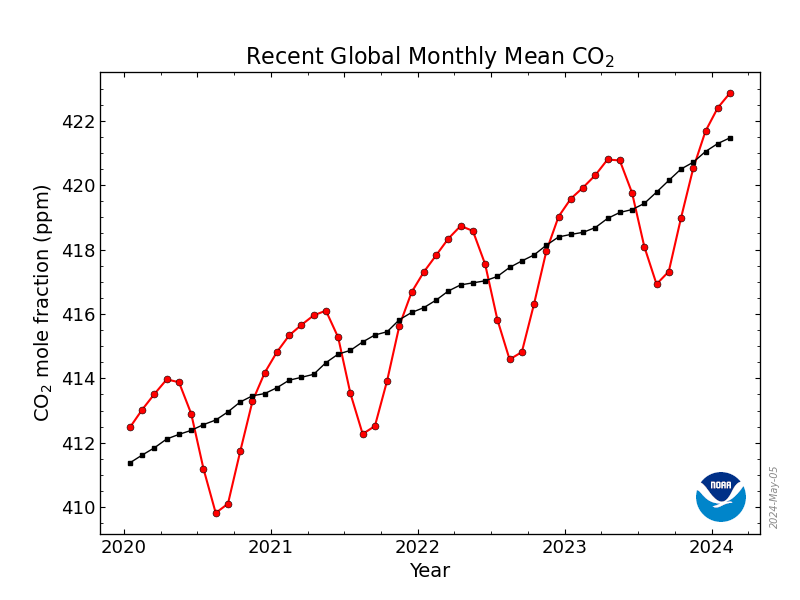
The world for humans continues to become more uncertain and more unstable; although you would largely not know that from our mainstream media. Climate Change is a little problem but we are working on it ,they say. Lets just ignore that we nowhere near achieving any of our much vaunted global targets of containing, let alone reducing, Co2 emissions- we are therefore definitely heading for global climate disasters in less than a decade.

Catastrophes like the recent flood devastation in Dera in Libya are third world issues, not our problem (and absolutely nothing to do with the avaricious Western world’s destruction of Gadaffi’s prosperous Libya (and his brutal death with a bayonet up his anus by Western supported jihadists, which US Secretary of State Hilary Clinton subsequently delightedly cackled about).

We are witness to an existential war in Ukraine, where, we are told, Ukraine will inevitable triumph against Putin and the evil Russians, but where in fact the West continues to coerce the Ukrainian military into sending thousands and thousands of its troops into slaughter against overwhelming superiority of Russian arms (Russian total air superiority, vast mine fields and overwhelming artillery capacity) .

And once independent academic analysts like Robert Patman in New Zealand along with the rest of the West, now regurgitate the nonsense of China being a threat to the West (and to New Zealand) and thus the appropriateness and necessity of the West continuing its brutal and sadistic “rule based international order” to confront both Russia and China.

Strangely too we hear very little mention in Western mainstream media of the drumbeat of a new multi-polar world. A world where the West can no longer dictate the economic terms through violence, war and blackmail of the South. Perhaps the images of African Sahel countries finally booting out their French colonial occupation forces raises some eyebrows in countries other than France, but there appears little recognition that this anti -Western movement is gaining steam across the South.

And strangely we how somehow not informed by mainstream media that the $6 billion that the US government has now so generously released to suppliers of essential goods to the Iranian population for the release of five Americans held by Iran for spying, was in fact Iranian state money stolen by the United States with their unilateral illegal sanctions against Iran, because of Iran’s non-existent nuclear weapons development.

Or perhaps you missed the very quiet admission by the US’s General Milley recently that the much hyped Chinese ‘spy’ balloons that drifted over the United States in February 2023 actually didn’t have any spy gear installed on them at all.

But hey, who needs facts when you need to inflame good white folks against the evil Russians,Chinese and Iranians ( let alone the North Koreans that the US committed 3 years of brutal genocide against in the Korean War).

And let’s just forget about climate change, what is more important than ensuring our global economy and consumerism keeps expanding?- right to the very end…

_________________________

Links

How Americans released in swap deal engaged in espionage activities in Iran (presstv.ir)

Boiling Frogs-again…

You of course know the old (true) metaphor) that frogs in a pot which is slowly heated up, can’t register when the water is too hot for their survival and get boiled alive..

Well, something very similar is now happening for humans across the Northern hemisphere.

Source photo: https://showyourstripes.info/c/europe/all

And something very similar is likely to begin occurring in the Southern Hemisphere in early 2024 with the advent of El Nino and the rapid rise in Pacific ocean temperatures.

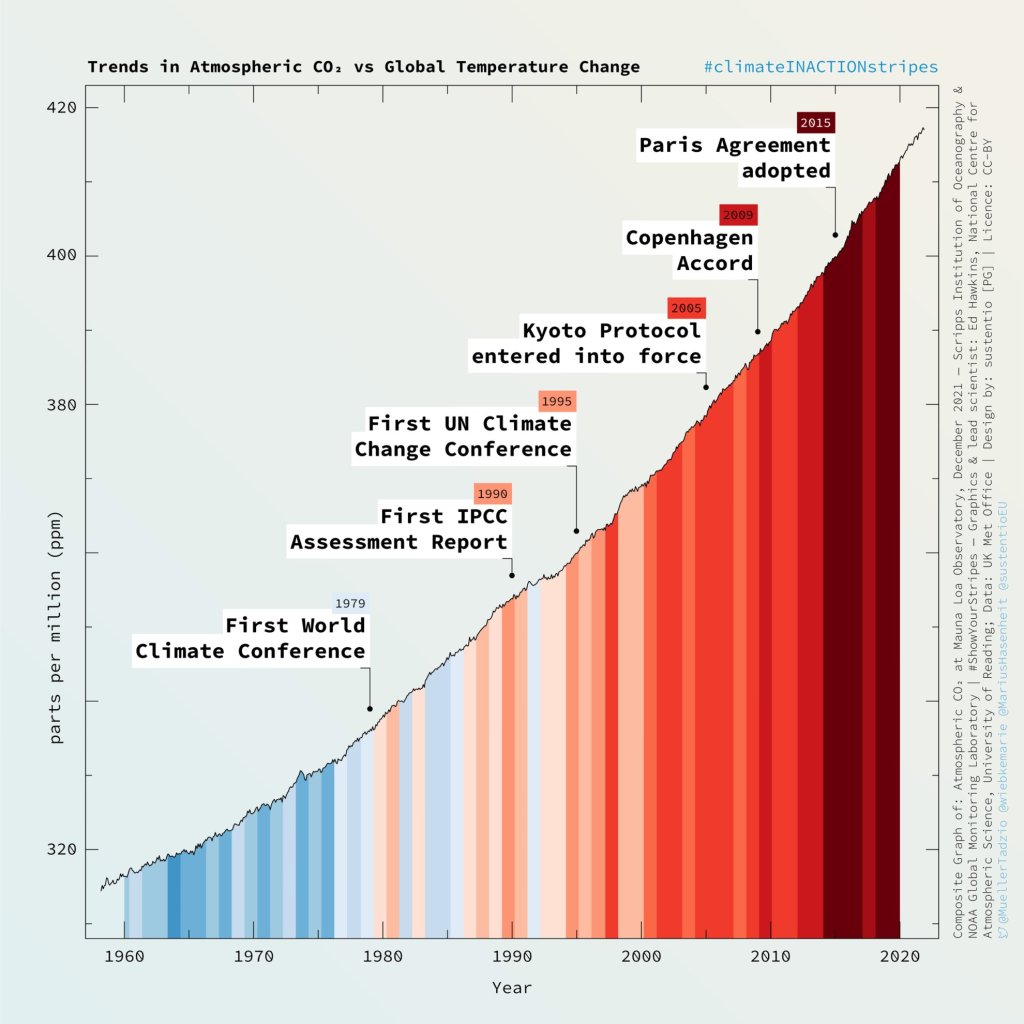
Source: https://research.csiro.au/acc/fifty-years-of-carbon-dioxide-co2-measurements-in-the-background-atmosphere-of-se-australia/

But it’s obviously all ok, because all our politicians around the world have far more important things to worry about– their next election defeat for starters, cosying up to big business for another, or sending another billion dollars’ worth of weapons to Ukraine. It’s as though climate catastrophe doesn’t really matter- if we just talk about it from to time and do nothing- that will placate the masses…

The response to the Greek Islands’ wildfires largely caused by climate change are just one of so many hypocritical and insane responses to climate change. The primary purpose of the fire response is not to eliminate the risks to vegetation and wildlife- oh no!-its to ensure that more tourists can flown in next year – and consequently ensuring that CO2 production from the thousands of tourist jets flying in and out of Greece ensure further climate catastrophe. Or we may give the example of why Paris has spent billions to clean up the Seine River -not to ensure river wildlife can return to the river after a century, but to ensure there will be millions of humans attending the Paris Olympics- all coming in on those CO2 producing jet planes from around the world…

Source : EDO https://edo.jrc.ec.europa.eu/edov2/php/index.php?id=1000

We need to ensure our communities can more easily adjust to the changes to our world and lifestyles that will occur whether we like it or not. Global trade will shrink as a result of more dangerous weather and destruction of sea, air and land routes. Transport insurance costs have already risen and will continue to escalate sharply as risks increase exponentially in the next few years. Local weather is becoming more and more unpredictable and dangerous. Multiple points of access to resources at a local level will become a priority.

In addition, to try and mitigate some of the impacts of global warming, species loss and destruction of soils and all the other species that we rely on for our survival, we need to urgently action the following.

In no particular order of priority (because they are all priorities), the following initiatives need to be initiated—NOW! …..

  • All food and products are produced within a 20km radius of major population centres. This limits both the transit/CO2 costs to the customer, and the transit costs of the producer.
  • Essential resources that cannot be produced or accessed locally are stockpiled in key places locally.
  • Transportation routes to other countries and locally, are multi-dimensional- ie different modes of transport which minimise biodiversity and climate harm.
  • All sales of goods account for their real costs to the environment.
  • All government and local government decisions take into account the environmental impact on emissions and biodiversity.
  • Businesses annually account and taxed for the environment costs of their business operations. All sales of goods account for their real costs to the environment.
  • All homes and businesses are retrofitted with high standard insulation. Where feasible solar panels are installed which link to the electricity grid.
  • Water from roofs is stored for either personal use or recycled into the water supply.
  • Urban areas and individual housing must have trees planted in every available area where food is not being produced.
  • All towns and cities are required to provide free or very low-cost community gardens and individual allotments for citizen food production.
  • Other species have the same rights as humans. A formal recognition by the UN and all state actors that all life is sacred and do not exist solely for humans’ benefit.
  • All products produced are capable of repair (or cannot be sold) and real recycling and repair occurs locally.
  • Governments and businesses are required to restore indigenous biodiversity to an agreed percentage each year.
  • Air travel is banned unless for absolutely essential business and family issues (e.g. tourism, global sports and cultural events are limited).
  • Solar, wind-powered or sustainably charged battery-powered sea, air and train vessels are developed and effectively utilised.
  • Farming is required to transition to sustainable practices within 10 years (no sprays, chemical fertilisers, and no ploughing- (use of permaculture, organic farming and biochar among other tools).
  • Indigenous trees are planted on a vast scale, on the understanding that they will never be cut down and ‘harvested’.

_____________________

The above initiatives may seem extreme to you- or even perhaps ridiculous and totally unnecessary. Why, you might say, can’t we, as Bill McKibben argues in his New Yorker article, simply return to 1960s levels of consumption?

The reality is that we have gone too far- way too far, beyond that. We have since had 80+ more years of consumption gone crazy, of CO2 production through the roof and an enormous amount of the biosphere destroyed. We not only need to stabilise humans’ impact on the living world we rely on for our existence, we need to start to actively repair it.

And yes, many of these proposals will have an impact on jobs; but without this forward planning job losses are going to be least of our worries- there will be little long term employment ins world of climate uncertainties and ongoing climate disasters.

Planning and actioning changes now, to cope with some of the enormous impacts climate change will have on our lives, will reduce some of the high risks of loss of income, food and essential resources that every one of us will face in our new climate world.

The alternative does not bear thinking about.

Postscript

In response to the recent US Congressional hearings on whether UFOs and aliens really exist, many of the U.S. public have stated that we really need to know whether we as human beings are really ‘alone’ in the Universe.

The unequivocal answer is of course that we are not alone, there are millions of sentient species right here on this planet that we have never bothered to try and communicate with as equitable partners. They may not look like us, behave like us, destroy the planet in the way that we do, (just like in fact our hypothetical alien friends from outer space would do), but they are, nevertheless our partners on this little world- and we are NOT alone!- let’s start to behave as though they really are our partners on this world!

______________________________________________

Links

https://www.sciencedaily.com/releases/2023/05/230517122123.htm

https://jonathancook.substack.com/p/why-action-on-the-climate-crisis?

http://www.paecon.net/PAEReview/issue96/Rees96.pdf

https://theecologist.org/2023/jul/31/future-what-future

World War Three

With the decision of the West to provide F16 fighters to the Kiev government we are heading rapidly closer to a world war.

It is not that the F16s are likely to be a ‘game-changer’ -as the Western media have called all of the previous Western wonder-weapons provided to Ukraine. It is the fact that the decision to provide these weapons is one more example of the West crossing the red-lines they promised they would not cross about the provision of more military support to Kiev.

Once it becomes evident that F16s are not going to provide the military advantage to Kiev that has been promised (Kiev cannot provide the necessary air support infrastructure to create a safe environment for the new fighters), nor can they match the newer generations of Russian fighters and its surface and air to air missiles), the next Western red-line will have to be crossed.

The West, after saying that training Kiev’s pilots on F16s would take at least 18 months, now says the training will take 4 months. This very likely indicates that the pilots flying the F16s will not be Ukrainian – they will be Western military ‘retirees’ or ‘volunteers’ and/or be operated out of Polish airbases..

Sow the seeds - US war poster

Kiev and the West is determined to ‘defeat’ the Russians in Ukraine- to ‘return’ Crimea and the Donbass to Ukraine (and then to carve up Russia in the way the neocons attempted to in the Yelstin years) . Given that President Putin gave the key rationale for the Ukraine invasion as protecting Russian speakers in the Donbass against neonazi Kievan troops, and given that Crimea has been a part of Russia since Catherine the Great annexed Crimea in 1783, a ‘return’ of Crimea and the Donbass to Ukrainian control would be an existential threat to the whole Russian Federation (not just Putin) and the Russian population would never accept that loss.

This is particularly so since Kiev has made it clear that it regards Donbass’ Russian speaking citizens as second class citizens who either have to be forced to speak Ukrainian or be exiled to Russia. Similarly Ukraine has made it clear that anyone in Crimea who has supported Russia (95% of the population at last count) will be deported to Russia once they ‘reassert’ control of the Crimean peninsula.

Western ‘intelligence’ and their military leaders are presumably aware of the existential nature of this war to Russia; although a knowledge of history and facts is not a prerequisite for decision-making in the US).

While NATO and the West insist they are not at war with Russia, the facts speak otherwise. Kiev’s military would have collapsed more than 6 months ago without NATO weapons; without NATO’s satellite and drone surveillance of Russian troops, without its ‘advisors’ on the ground in Ukraine, without the training of Kiev’s troops to use NATO weapons, and without the ‘retired’ NATO military ‘volunteers’ on the front line. NATO thus continues to pretend that its only providing ‘assistance’ to Kiev- the reality is very different – this is a NATO war.

It is now a very small step for NATO soldiers with NATO uniforms to be on the ground in Ukraine and supporting Kiev from NATO airbases and missile sites in Europe. Once that final line is crossed-possibly in the next few months, China will have no choice but to enter the war on Russia’s side. China has certainly provided economic support but likely no overt military support to Russia since the war began, and is fully aware that once Russia is disposed of and carved up, (as NATO strategists have made clear is the goal) they will be next.

The extension of the military ring around mainland China and the recent development of a second AUKUS/NATO military containment ring in the Pacific with New Guinea and other Pacific nations, plus the West’s universal abrogation of the ‘One China’ principle regarding Taiwan that the West had previously signed up to, are clear signals to Beijing that war with China is coming, and coming soon. Russia must survive for China to survive.

China continues to play a constructive and peace-making role in Ukraine as Patrick Lancaster notes, although to date, without success, unlike its outstanding recent success in brokering peace between Saudi Arabia and Iran to the great consternation of the U.S., U.K. and Israel, who had hoped that an Iran/Saudi confrontation would be the catalyst for regime change in Iran and access to its oil once again as in the ‘good old days’ of the brutal American controlled Shah.

The United States is desperate to ensure that it maintains total control of the economic strands of the global economy; it rightly sees the expansion of non-US dollar transactions as a major threat to it’s control, and its consequent capacity to threaten and cajole and extract the wealth of other nations who do not obey their wishes. And there are many in the West who are quite deranged enough for the world to endure World War 3 so that the West’s avaricousness can be maintained.

If the dollar collapses, the United States already in huge debt, will collapse rapidly. Its capacity to maintain its 600 plus military bases around the world will cease – and like the decline of the Roman Empire on fast forward, its military men will return home to vent their frustrations on the Empire.

Thus neither side in this war can afford to lose. Those of us on the periphery of this battle of the giants, need to maintain our safety as best we can!

______________________________________

Links

https://www.theguardian.com/commentisfree/2023/may/28/the-moment-has-arrived-biden-must-give-ukraine-all-it-needs-to-win

A not so Brave New World

COP27, the meeting of the rich and powerful with a smattering of people who actually know something about global warming and its impacts, was a total disaster for the planet. No agreed reductions in fossil fuels but an agreement to ‘compensate’ poorer countries for the impact that rich countries ongoing CO2 production will have on their local environment.

The fact that there were at least 36 private jets which flew participants into the COP27 conference, spewing huge amounts of CO2 into the atmosphere is one small demonstration of what these conferences are about- looking good and taking no action while our living planet dies.

While there were many indigenous peoples attending the COP27 who were able to voice their concerns about the current state of the earth and make suggestions for change, their voice had absolutely no weight in the final decisions made by the big power-brokers ( who depend on a CO2 producing economy to keep the electoral money rolling in).

Those indigenous groups talked not only about climate change, but more importantly, about the loss of biodiversity and our dis-connection with the rest of nature which industrialization and commodification has done to our beautiful living world in the last 200 years. Without our fellow living things on this planet ; we are done .

The idea that giving some money to a poor country to compensate for a now unsolvable problem of environmental destruction is frankly bizarre, and amply demonstrates that mental vacuity of those rich and powerful people.

No doubt the money will be useful and may help poorer countries mitigate the losses to their local ecosystems and help humans survive in their devastated environment a little longer, but in many cases that money will simply be spent on more ‘development’ and ‘progress’ and thus more environmental destruction.

And as we can already begin to see, many of the global ‘rich’ countries are already struggling to cope with the environmental ‘costs’ to their own economies, so their capacity to pay anybody else for their own stupidity is soon going to be substantially diminished.

Everywhere we see the powerful and the media portraying climate change as some little problem we can solve- at some stage- but lets get on with the business of despoiling the planet now -while there’s money to be made!

I see sublime examples of this on my local state television news channel, who in one news segment show how our magnificent government has made some new pledge to reduce carbon emissions and the next news segment extols the virtues of that same government encouraging tourists from half way round the world to travel to New Zealand.(and home again). Those enormous jet plane carbon emissions (about 5 tonnes of Co2 each way) will of course not be counted in New Zealand’s carbon emissions but to the tourist’s home country, so naturally everything is ok!

We will undoubtedly exceed 1.5C increases in global temperatures in the not so distant future , and will also certainly reach 3.5C increases if we do not dramatically reduce our consumption of energy globally. Green energy solutions; solar, wind and wave can make that transition a little easier, but they cannot ever replace the quantity of energy from oil gas and coal we continue to consume at ever increasing rates.

We all need to come to terms with consuming less and helping to recreate the natural world .

If we don’t, and very soon, Nature will decide for us in not so pleasant ways.

_____________________________________________

Links

https://doomberg.substack.com/p/exit-stage-left?

There is(apparently) only one ‘Truth’

New Zealand Prime Minister Jacinda Ardern has it seems irrevocably pinned her flag to the mast of the ‘dark side’- the U.S. ‘rule based order’ ( not to be confused with the UN charter of human rights or anything silly like that, but with the right of the YS to do anything it damn well likes to any country and people it pleases. (bombing an allies’ gas pipeline is just one of so many examples)

Once a president of ‘International Union of Socialist Youth’, which among its neoliberal causes, supposedly also stands for ‘Social justice and democracy – to ensure participation for all citizens based on the principles of freedom and equality, against authoritarianism, populism and dictatorship; for the right to self-determination, to liberty, and freedom of expression of all peoples‘- Jacinda is now calling for the world to install what Zerohedge calls a ‘world censorship system’

Whil insisting there is only one truth in regard to world conflicts (no room for peace negotiations there!) she also insisted there could only be one view about climate change. As one who does not deny the reality of climate change, I find it astonishing that Ardern suggests we can legislate climate impacts away by saying we will not allow the world to increase global temperatures by 1.5C.

Either she is amazing badly informed by her science advisors about climate change, or she is simply posturing. The reality is that it is now inevitable that the world will experience much more than 1.5C warming. Governments across the world (including her own) have talked a lot about climate change impacts and what should be done- but have in fact done nothing more than pretend to their voters they are doing something. Co2 global production continues to increase, not decrease.

And in fact Ardern’s government has continued to push for more international tourism (which in New Zealand results in massive production of Co2 from the passenger jets winging their way around the world to the South Pacific from the Northern hemisphere), more extensive dairy and agribusiness farming which continues to destroy our environment in multiple ways and generally more ‘progress’ (which means more businesses which inevitably destroy more of the environment and induces more consumption of goods people don’t need.

Ardern and her Labour are like her National Party opposition and all the other New Zealand political parties, locked into requiring financial support from businesses- and ‘more business’ and ‘progress’ are simply euphemisms for making money from environmental destruction.

But, to return to the earlier argument about there being simple single truths about the Ukraine war; that a democratic Ukraine with ‘European’ values of tolerance and freedom is fighting against a relentless ruthless behemoth of Putin’s Russian Empire, we might put forward a counter ‘truth’. That Ukraine is in fact a brutal single party white supremacist state whose only reason for Western support is to defang the Russian bear so that Western corporations can once again (as in the Yeltsin years) begin to appropriate Russian assets at bargain prices.

As the Scrum notes: Incited by Western powers, Poland, Lithuania, and the Habsburg Empire, the key to Ukrainian nationalism was that it was Western, and thus superior. Since Ukrainians and Russians stem from the same population, pro-Western Ukrainian ultra-nationalism was built on imaginary myths of racial differences: Ukrainians were the true Western whatever-it-was, whereas Russians were mixed with “Mongols” and thus an inferior race. Banderist Ukrainian nationalists have openly called for elimination of Russians as such, as inferior beings.

https://twitter.com/i/status/1577289845155983361

The destruction of the Russian state was the prime agenda for UK and US ‘intelligence’ operatives after the second world war, making enthusiastic use of Ukrainian neonazi groups like Stepan Bandera’s OUNB and then latterly with OUNB’s successors like the Right Sector and their militants the Azov and Aidar battalions, and the consequent overthrow of the corrupt (as every Ukrainian president has proved to be) but democratically elected President Yanukovych in the US backed Maidan revolution of 2014.

Western intelligence has since played a major role in re-arming the Ukrainian army and the neonazi militant groups to not only get rid of the problem of Russian speaking Ukrainians in the Dombas, but also to fight a war with Russia itself.

These Ukrainian ultra-nationalists have also been enthusiastically supported by strong Nazi elements in the Baltic States, Germany, Poland and the Ukrainian post WW2 diaspora, particularly in Canada.

So, naturally, any compromise in the grand Western agenda, not to mention a reduction in the Western PR media effort to discredit Russia (and now China) in any way possible how ever implausible, is completely impossible- peace negotiations are not an option. Nuclear war with Russia is also being promoted in Western media as also an option, deliberately misrepresenting (as Scott Ritter-former UN weapons inspector notes)the Russian position on first use of nuclear weapons.

The ‘perhaps’ unintended consequence of this glorification of the ultra-nationalist agenda, along with the self-destruction of European economies causing poverty and anger and demonstrations on the street, is the resurrection of the white supremacist ultranationalist movements, like Zelensky’s, across Europe.

First in 2022 we saw the ‘Sweden Democrats’ far-right movement gain political power in Stockholm and then the ascendance to power in Italy of the ‘Brothers of Italy’-a direct descendant of Mussolini’s fascist party.

These far-right groups not only celebrate intolerance of minorities, but also any dissent of the view that the state is pre-eminent in all things, that the corporations should rule in tandem with government (as in the US), and that consequently any collective view of humanity outside of the state apparatus is a threat to be stamped out.

However the far-right’s biggest threat to humanity is their denial of the climate change disaster. How can the state become strong in their view, without industrial ‘progress’ and a strong war-machine?

We can already see that view reflected in those European ‘moderate’ parties who currently control the EU. They’ll talk about mitigating climate change and green energy and all those cute things, as long as it doesn’t impact on the economy and the money that rolls into party coffers from the corporations-‘fire up the coal boilers for electricity again ‘cos we need to destroy Russia first!’

We are, after all, talking about Jacinda Ardern’s favourite ‘international rule-based order’ here!

Let’s get our priorities straight with the one true Truth!

_______________________________________________

Links

https://thescrum.substack.com/p/a-cia-theme-park?

https://consortiumnews.com/2022/09/30/scott-ritter-the-onus-is-on-biden-putin/

https://thescrum.substack.com/p/revanchism-in-germany

https://original.antiwar.com/mcgovern/2022/09/25/nyt-on-ukraine-vietnam-dj-vu/

https://www.zerohedge.com/news/2022-10-05/uks-secret-diplomacy-and-european-wars